
Osamu Dazai’s No Longer Human: A Comprehensive Analysis
What is to be human? Many answers can be and have been written in response to this age-old philosophical question. Maybe it is the ability to think rationally, or perhaps we are, as Aristotle states, “social animals”.
Yet knowing how and why the world works this way is sometimes never enough for those who accept the fact that they cannot seem to understand themselves. People love to argue: who can understand me better than myself? But if we must ask and learn about ourselves, then – will we realise the extent of our own true nature? If we do, would that awareness do us any good? This is explored by famous Japanese novelist Osamu Dazai in his novel No Longer Human, which also reflects the writer’s truth and his life to a certain extent.
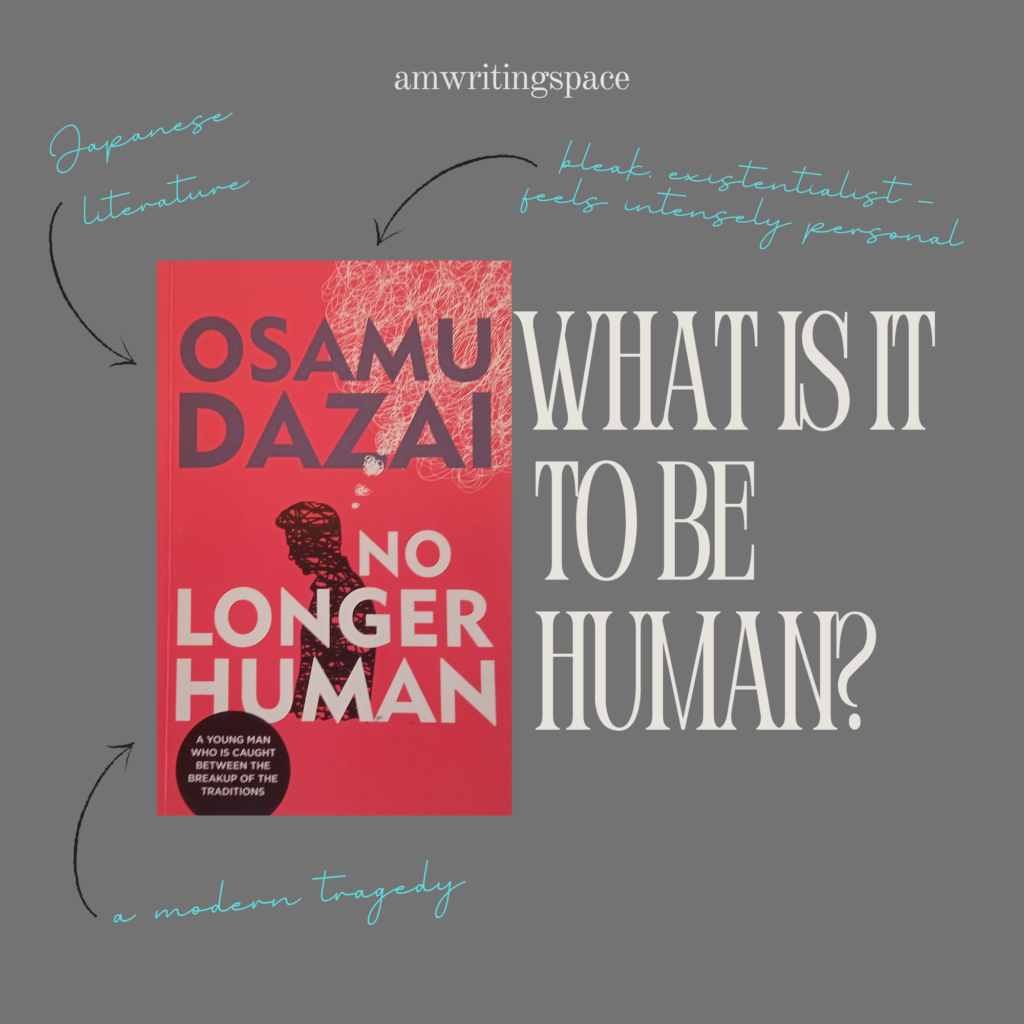
No Longer Human follows the life of Oba Yozo, a young man who struggles with depression, drug addiction, alienation and multiple suicide attempts.
More than anything, he fears humans and his extreme distrust in the society estranges him completely, until he is “disqualified as a human.”
I had known about this novel for a long time, first encountering it while researching psychoanalytic literary theory for a research paper. When I finally got to read it in the beginning of 2026, I realised that it is not the type of book to have an easy opinion about. The novel will prove unsettling and disturbing. At times, you might sympathize with Yozo; and at other times, you’ll be unable to defend or pity him. There is no comforting catharsis. The reader will only absorb each and every dreadful thought, shame and paranoia without any relief by the end. At least, there wasn’t for me.
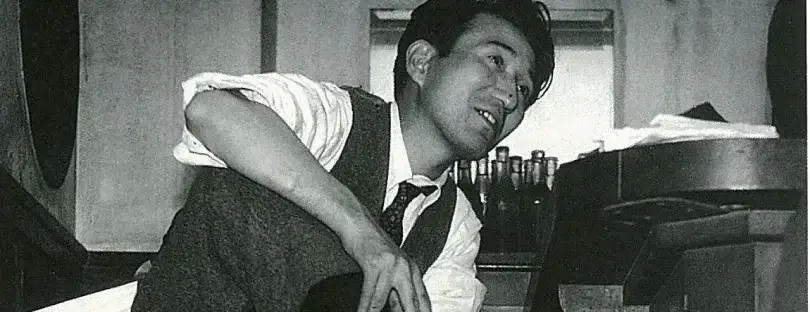
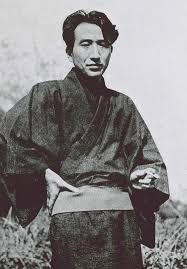
It is impossible to discuss this novel without addressing the life of its author, Osamu Dazai. One can uncertainly but still instinctively mark passages in the novel which can also be found in the author’s life. What I didn’t know was that Osamu Dazai is the pen name. His real name is Shuji Tsushima. Dazai himself struggled with severe depression throughout his life, and tried committing suicide multiple times. No Longer Human was his last semi-autobiographical novel, published in 1948, months before he committed suicide with his lover Tomie Yamazaki. The novel holds so much reflection of Dazai’s life that it becomes easy to forget that there are parts of this novel that are fictitious.
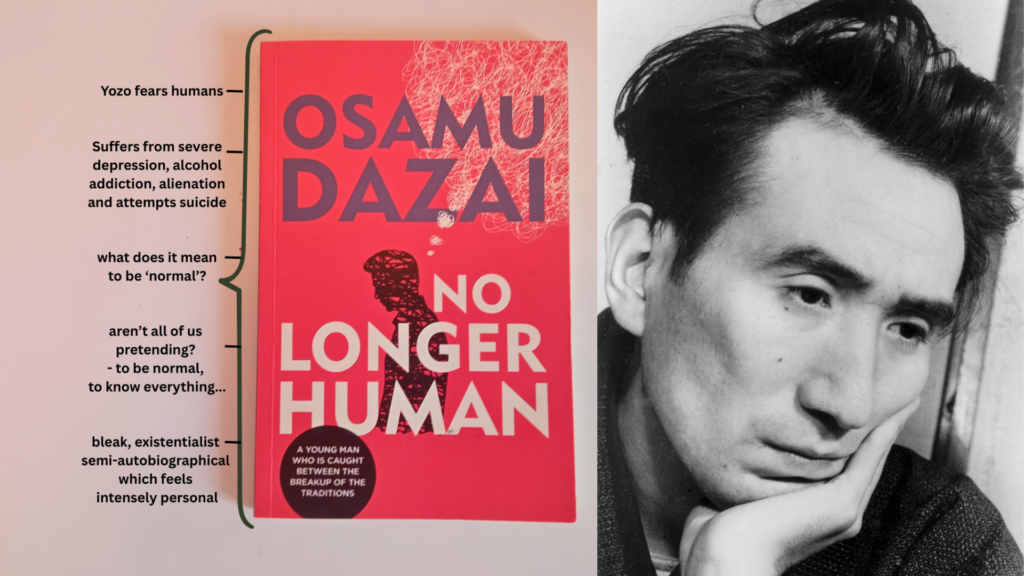
The novel is written in a stream of consciousness manner, narrated in first person which was quite a prominent feature in Dazai’s writings. No Longer Human’s narrative is presented to us by an unnamed narrator, who is in possession of three pictures and three notebooks of Oba Yozo. Such framing reminds us that what we are reading could possibly have inconsistency in thoughts or possibly, distorted.
Maybe that is why the novel feels intensely personal, as if Dazai is trapping and isolating you as well, making you question the society and what it means to be human, in a similar manner. His writing is such, that it creates an unescapable tension.
Oba Yozo in No Longer Human
The first notebook opens with Yozo narrating his thoughts, the first confessional line itself sets the tone for the whole book.
“Mine has been a life of much shame.“
Oba Yozo’s life since childhood until his late twenties, is a life marked by alienation. Even as a child, Yozo struggled to make an understanding of his parents or older brother’s sentiments towards him, let alone interact with them or others in the society. His social anxiety appears to be rooted in part, in a sexual assault by a servant in his own home [when he was a child]. This event is narrated vaguely, which reinforces the possibility that Yozo is an unreliable narrator.
This incident causes him to develop an innate distrust in humans. He isn’t even able to communicate his torment to his parents, because he knows they’ll judge him. Yozo struggles with extreme self-awareness, since his childhood. He scrutinises human speech and behaviour, and finds all of it deceptive and impossible to comprehend.
To appear normal – to look like a part of society – he does what I believe we all actually do which is pretence. He pretends to be like other humans. It is both a result and reinforcement of his social anxiety, as Yozo finds himself to be completely disconnected from the world. Yozo disguises his disoriented feelings and nature by playing the role of a clown. The mask of an entertainer works because all of his family members, classmates and teachers like him.
This does make me think that “normalcy” is just an elaborate act, and we are all actors on stage – pretending that we know what we are doing, what we are saying or what life ultimately means, when in reality we may know very little to nothing.
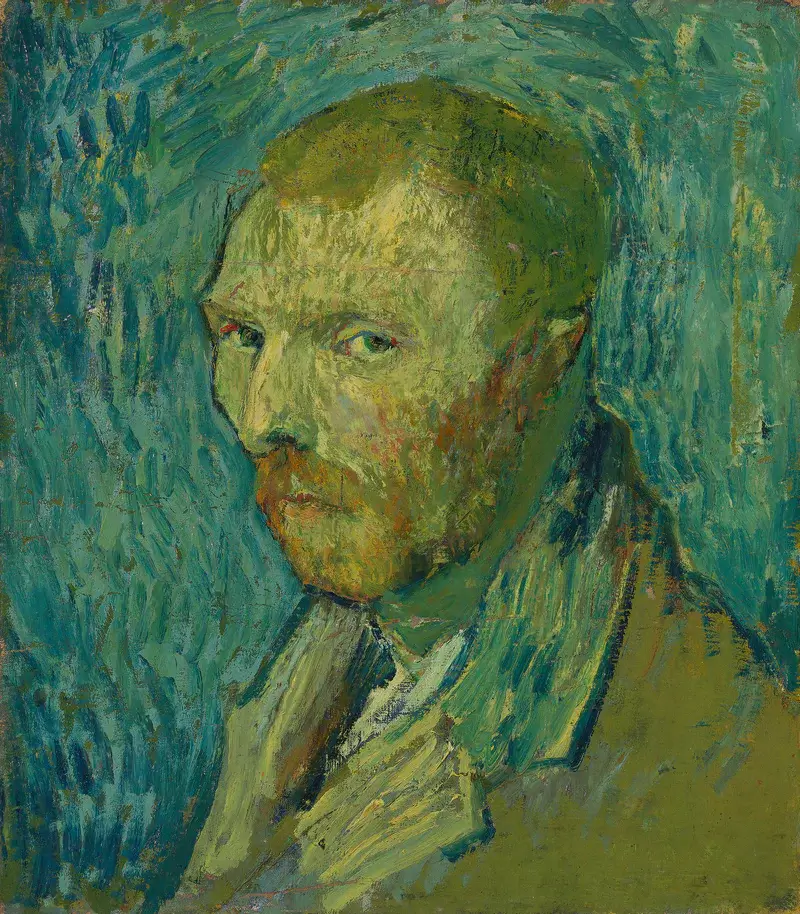
Yozo finds his true self in the paintings by Van Gogh and Modigliani, which is the only thing that helps him escape this world. Yozo notes,
“There are some people whose dread of human beings is so morbid that they reach a point where they yearn to see with their own eyes monsters of ever more horrible shapes.… Painters who have had this mentality, after repeated wounds and intimidation at the hands of apparitions called human beings, have often come to believe in phantasms – they plainly saw monsters in broad daylight…”
This drives him to paint images of ghosts and his own self-portraits – all in secret. He shows them to only one of his peers, Takeichi [in the second notebook], and Takeichi predicts two things about Yozo – first, he’ll be a great painter; and second, all women will fall for him. The second, indeed, becomes a reality.
No Longer Human: A Modern Tragedy
From this point, No Longer Human starts taking the shape of a modern tragedy. Yozo befriends a character named Masao Horiki, a narcissist who holds an inflated opinion of himself. After which Horiki’s influence leads Yozo to seek a greater escape from his extreme anxiety and dread of humans, in alcohol addiction and prostitutes. His relationship with women remains deeply conflicted: he becomes a womanizer while harbouring fear and resentment towards them, because of his childhood trauma. He admits that women are even more difficult to understand than men.
Here, one begins to see fragments of Dazai’s own life reflected in Yozo’s life. How similar to Yozo, Dazai also began neglecting his studies – especially after the suicide of his favorite author, Ryūnosuke Akutagawa. Dazai developed a serious drinking problem as well. Around this time, he also became affiliated with the banned Japanese Communist Party, mirroring Yozo’s impulsive involvement with Marxism. Both men would attempt to suicide with a young Geisha [bar hostess], and survive, while the women in both cases, would die.
Yozo particularly has no ambitions, nor does he have any dreams. His character is dominated by fear of humans. Yozo’s disconnection causes alienation and also results in low self-esteem. Sometimes, he begins to perceive himself as evil or someone who will eventually bring tragedy upon anyone, especially women associated with him. This perception is caused by Horiki’s comments.
To a certain extent, tragedy does follow him. However, Yozo is such a complex character that he cannot be judged on that surface level. And who are we to judge him so easily?
I did wonder – briefly – whether had he devoted himself more sincerely to his love for art, could it be that he might have escaped his tragedy? But that thought feels naive. Yozo is a psychologically disturbed character – not in the criminal sense that Horiki suggests, but in a far more internal way. He is incapable of inheriting conventional human moral values because he does not recognize himself as human in the first place.
As a reader, it becomes impossible to pity him as the novel progresses. But, it also becomes increasingly difficult to understand events clearly, since it’s unfolding from Yozo’s isolated and distorted perspective. Yozo has always silently borne his own suffering, which inevitably results in his indecisiveness as well – when his wife, Yoshiko, is being sexually assaulted and he walks away without uttering a single word in shock. After this incident, his distrust of human beings crosses all boundaries, and he begins to lose complete sense of comprehending reality.
Yozo is, again, such a terrible and unreliable narrator which is given in such novels, that it becomes difficult to assess Yoshiko’s situation as a victim of sexual assault. When they first met, Yoshiko had a positive impact on Yozo. She is kind, naive and too trustful of people around her – qualities which inspires in Yozo a fragile hope that he might transform into a better human.
“It was less the fact of Yoshiko’s defilement than the defilement of her trust in people which became so persistent a source of grief as almost to render my life insupportable. For someone like myself in whom the ability to trust others is so cracked and broken that I’m wretchedly timid and am forever trying to read the expression on other people’s faces, Yoshiko’s immaculate trustfulness seemed clean and pure, like a waterfall among green leaves. One night sufficed to turn the waters of this pure cascade yellow and muddy.“
I will not dwell on the obvious problematic age difference or the inherent misogyny rooted in his distrust of women. What becomes crucial, however, is that it is this very trustfulness of Yoshiko that, in Yozo’s words, becomes a sin and leads to her violation. In his mind, her innocence becomes culpability. This drives Yozo into paranoia. He questions her virtue and accuses her if she might be an infidel, unable to process Yoshiko’s trauma from his fragile crumbling world view. As for Yoshiko, she is left traumatized – living in a state of constant anxiety, now similar to Yozo. It is heartbreaking to see her spirit be destroyed in similar fashion as Yozo too.
Soon after, Yozo descends into morphine addiction to cope with this incident and by the end, he is tricked into getting admitted into a mental health hospital. For Yozo, this serves as a final confirmation. He has finally ended up in a place meant for those who aren’t “normal”. Thus, becoming “Disqualified as a human being” [No Longer Human].
“Disqualified as a human being.
I had now ceased utterly to be a human being.“
Yozo is a tragic character. The novel offers no redemption. Neither it offers any hope, and if there is any, then the unbearable suffering suffocates that hope repeatedly. Life remains tormenting and bleak for Yozo. His only escape from life is death.
And perhaps, that is why it unsettled me so much. Because this question does arise in our minds every now and then, when we are simply tired or done with dealing with everyone – why do we even live? To ultimately die? I’m not certain what answer I can offer to that question. But I do know that outside the novel, life goes on – whether we understand it or not. And I truly believe the best we can do is live. That’s more than enough.
I would like to revisit this novel in original language, once I gain fluency in Japanese. As lovely as the translation was, it will however, never match the original text. Despite bleak existential dread gripping me throughout the read, I did enjoy my first experience with Japanese literature. The next book that I’m currently reading is The Makioka Sisters by Junichiro Tanizaki, and for now it’s proving to be a good breakaway from existentialist fiction.
2 Comments
Anonymous
Really good
Giyu
GOOD